
myeasypage Blog
Hindu Marriage Biodata Format — Free Template Download (2026)
A complete guide to the Hindu marriage biodata format — what to include, gotra and manglik fields, regional variations, and how to download a free professionally designed template. No signup needed.
A Hindu marriage biodata is more than a resume. It communicates family background, community alignment, and personal character to the other family before any direct conversation happens.
Getting the format right matters. A poorly structured biodata gets skipped. A well-structured one creates a good first impression before anyone picks up the phone.
This guide covers everything: what fields to include, what to skip, regional variations within Hindu communities, and how to create and download a free template.
What Makes a Hindu Marriage Biodata Different
Unlike a general marriage profile on a matrimony app, a printed or PDF Hindu biodata carries specific religious and community fields that families use to check compatibility:
- Gotra — the lineage of the family, critical in Brahmin, Kshatriya, and many other communities
- Manglik status — whether the person is manglik, partial manglik, or non-manglik (based on Mars placement in horoscope)
- Sub-caste / community — Brahmin, Vaishya, Rajput, OBC community names, etc.
- Mother tongue — especially relevant for cross-state marriages
- Kundali / horoscope — some families attach a separate kundali; others note the birth details in the biodata
Not every Hindu family uses all these fields. A modern urban family may skip manglik status entirely. A traditional family may require the full gotra lineage. Know your context before filling these fields.
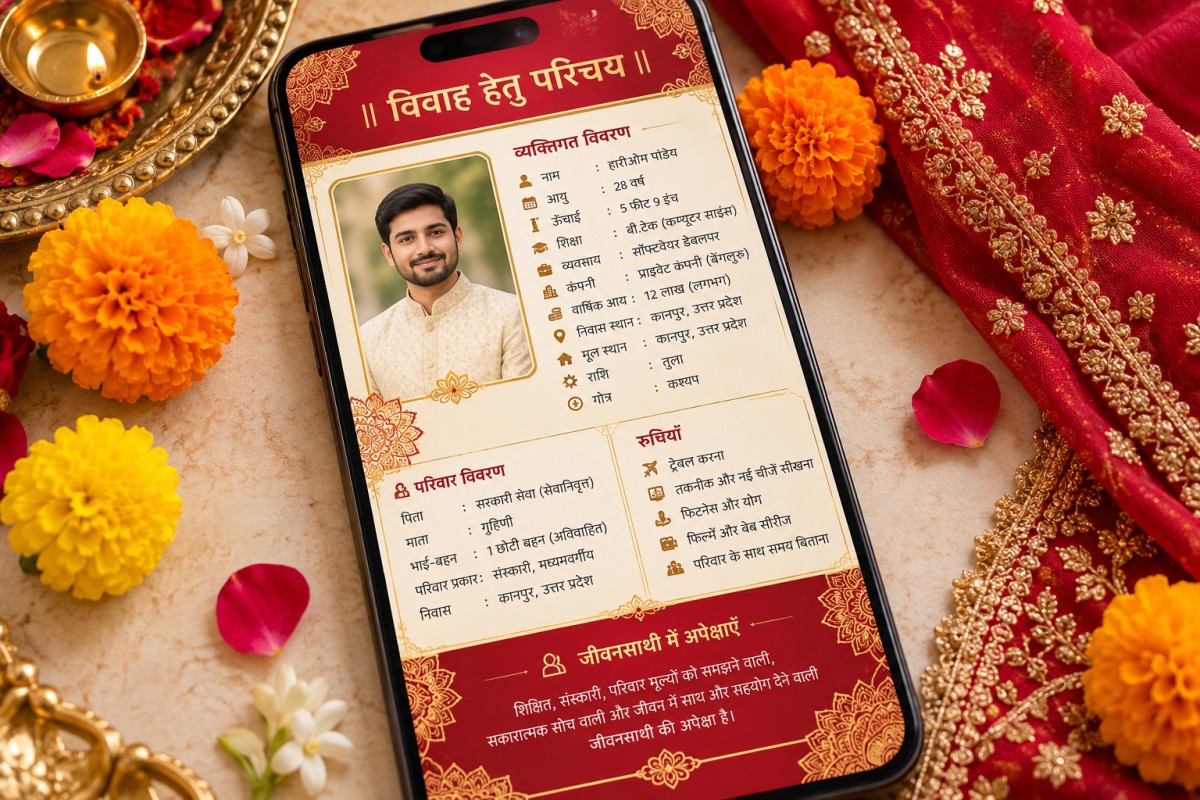
Complete Hindu Marriage Biodata Format
Section 1 — Personal Details
| Field | Notes |
|---|---|
| Full Name | As it appears on official documents |
| Date of Birth | DD / MM / YYYY |
| Time of Birth | For kundali matching — as accurate as possible |
| Place of Birth | City / district |
| Age | Complete years |
| Height | Feet and inches |
| Complexion | Fair / Wheatish / Dusky — be honest |
| Blood Group | Optional |
| Marital Status | Single / Divorced / Widowed |
Section 2 — Religion and Community
| Field | Notes |
|---|---|
| Religion | Hindu |
| Caste | Brahmin / Kshatriya / Vaishya / OBC / etc. |
| Sub-caste | More specific community name |
| Gotra | Important for Brahmin and many other communities — same gotra marriages are not allowed in many traditions |
| Mother Tongue | Hindi / Marathi / Tamil / Telugu / Gujarati / Bengali / etc. |
| Manglik Status | Yes / No / Partial (Anshik Manglik) |
| Nakshatra | Birth star — needed for kundali matching |
| Rashi | Moon sign |
Section 3 — Education
| Field | Notes |
|---|---|
| Highest Qualification | B.Tech / MBBS / MBA / CA / MA / etc. |
| University / College | Mention if reputed — NIT, IIT, AIIMS, IIM carry weight |
| Year of Completion | Optional |
| Additional Certifications | Relevant professional certifications |
Section 4 — Career and Income
| Field | Notes |
|---|---|
| Current Profession | Full title, company, city |
| Annual Income | Give a range — ₹10-12 LPA is better than a blank |
| Future Plans | Mention if planning to go abroad, do higher studies, start a business |
| Business (if applicable) | Nature of business, turnover — for self-employed candidates |
Section 5 — Family Details
| Field | Notes |
|---|---|
| Father | Name, profession, city |
| Mother | Name, profession (mention if homemaker) |
| Brothers | Count, education, married / unmarried |
| Sisters | Count, education, married / unmarried |
| Family Type | Nuclear / Joint |
| Family Background | 1-2 lines about overall family values and lifestyle |
Section 6 — About Myself
3-5 sentences. Keep it specific, not generic.
What NOT to write:
I am a simple, honest, and family-oriented person.
Every biodata says this. It means nothing.
What TO write:
I work as a chartered accountant in a Mumbai-based firm. I enjoy cooking, reading about Indian history, and following cricket. Im looking for a partner who values open communication and has a sense of humour. Family gatherings are important to me."
This tells the other person something real.
Section 7 — Partner Preferences
Be realistic and reasonably flexible. Overly narrow preferences reduce genuine matches.
| Field | Example |
|---|---|
| Age Range | 24-29 years |
| Education | Graduate and above |
| Profession | Working preferred, open to homemaker |
| Location | Mumbai / Pune / Open to relocation |
| Community | Maharashtrian Brahmin preferred, open to other Hindu communities |
| Manglik Preference | Non-manglik preferred / Open |
Section 8 — Contact
- Father's name and mobile number (or whoever is handling the search)
- Email address (optional)
- City
Regional Variations in Hindu Biodata
Hindu biodata format varies significantly across states and communities:
North Indian (Hindi belt) biodata:
- Gotra is essential
- Manglik status prominently mentioned
- Income mentioned openly
- Extended family (chacha, mama) sometimes mentioned
South Indian Hindu biodata (Tamil, Telugu, Kannada):
- Nakshatra and Rashi are primary compatibility fields
- Star sign matching is critical — the horoscope section is more detailed
- Jathakam or horoscope is often attached separately
- Income may be mentioned as a range
Marathi biodata:
- Community (e.g., Kokanastha Brahmin, CKP, Kunbi) is specifically mentioned
- Kul (family deity) is sometimes included
- Regional cities (Konkan / Vidarbha / Pune) noted
Gujarati biodata:
- Business background and family business details are important
- Sub-community (Leva Patel, Kadva Patel, Anavil Brahmin, etc.) is specific
- May include family's home village or ancestral town
Bengali Hindu biodata:
- Community (Brahmin, Kayastha, Vaidya, etc.) is specific
- Education is heavily emphasised
- Gotra is used but with different significance than North India
What to Skip in a Hindu Biodata
- Salary down to the rupee — give a range
- Negative traits or dealbreakers in the preferences section — discuss these in conversation
- Generic personality descriptors (simple, decent, honest) — use specific details instead
- Old, low-quality photos — use a recent, clear photo
Download a Free Hindu Marriage Biodata Template
You can create a professionally designed Hindu marriage biodata with myeasypage's free biodata maker:
- 5 premium templates — Royal Classic, Floral Wedding, Modern Editorial, Minimal Clean, Festive Sangeet
- All Hindu-specific fields included (Gotra, Manglik, Nakshatra, Rashi)
- Photo upload
- Download as PDF, PNG, or JPG
- No signup required, completely free
[Create your Hindu biodata now →](/tools/marriage-biodata-generator)
Frequently Asked Questions
Does gotra need to match for Hindu marriages? No — in most Hindu communities, same-gotra marriages are traditionally not allowed. The couple must have different gotras. Check your specific community's tradition if unsure.
What if I am partially manglik (Anshik Manglik)? Mention it as Partial Manglik or Anshik Manglik. Some communities treat this differently than full manglik. Many modern families don't use manglik status as a filter at all.
Should I attach my kundali with the biodata? That depends on the family. For conservative or traditional families, attaching a separate kundali is expected. For modern urban families, a note of birth date, time, and place in the biodata is sufficient — they'll ask for kundali separately if needed.
Is it okay to write a biodata in English? Yes. Most matrimonial biodatas today are in English, even for traditional families. If both families are Hindi-speaking and prefer it, a Hindi biodata is also fine. The content matters more than the language.