
myeasypage Blog
We Looked at 200+ Marriage Biodatas — 8 Mistakes That Are Costing Real Matches
Most marriage biodatas look acceptable but fail silently — no replies, no rishtas. After analysing 200+ real biodatas shared on matrimonial platforms, we found the same 8 mistakes appearing again and again. Fix these and your biodata goes from ignored to responded to.
Here is something nobody tells you when they hand you that blank biodata template.
The families on the other side are reading 15–30 biodatas a day.
Theyre tired. Theyre scanning, not reading. In under 45 seconds, they've already decided whether to share your biodata with the main family group chat or quietly move to the next one.
Your biodata has one job: survive that 45-second cut.
Over the past several months, we collected and analysed more than 200 real marriage biodatas — shared by users on our platform, submitted on matrimonial sites, and passed through family WhatsApp groups across India and among NRI communities in the US, UAE, UK, and Canada.
What we found was not random. The same 8 mistakes appeared in biodata after biodata. And in almost every case, these mistakes were the reason a genuinely good profile was being silently skipped.
Here they are — along with the exact fixes.
Mistake #1: The "About Me" That Describes No One in Particular
The single most common mistake. And the most damaging.
Here is what a typical About Me on a marriage biodata looks like:
"I am a simple, caring, and family-oriented person who believes in traditional values with a modern outlook. I enjoy spending time with family and friends. I am looking for a life partner who is understanding and supportive."
Read that again. Could that not describe literally anyone? There is nothing in those three sentences that is specific to you, your personality, your actual life, or your values.
Families reading 20 biodatas a day see this paragraph — word for word — on at least 15 of them.
What a Specific, Memorable "About Me" Looks Like:
"I grew up in a defence family — we moved cities every two years, which made me adaptable, independent, and genuinely comfortable meeting new people. I work as a paediatrician in Pune, and outside the clinic I am most likely to be found at a Carnatic music class or planning a solo trek. I want a marriage that has warmth, honesty, and a shared sense of humour — not just shared traditions."
Same length. But this one is specific. It shows character. It signals compatibility. It gives the other family something real to respond to.
The Fix:
Answer these four questions in your About Me:
- What shaped you? (family background, upbringing, major life experience)
- What do you actually do day-to-day? (beyond just job title)
- What do you genuinely enjoy? (specific hobbies, not generic ones)
- What kind of marriage or home life are you imagining?
Be honest. Be specific. Be yourself — not a template version of yourself.
Mistake #2: A Photo That Works Against You
Your photo is the first thing that gets looked at. In many cases, it determines whether the rest of the biodata is read at all.
Here is what kills a biodata photo:
- Formal passport-style mugshot — stiff, expressionless, unflattering background
- Group photo cropped to show just you — confusing, low quality, looks lazy
- Photo from someone's wedding — everyone around you, heavy makeup, unclear who you are
- Poor lighting, blurry, or low resolution — signals you didn't take this seriously
- Photo from 6 years ago — when families meet you in person, the gap in expectations creates awkward tension
What a Good Biodata Photo Looks Like:
- Clear, solo photograph of your face and upper body
- Natural, comfortable expression — not stiff, not overly posed
- Good natural lighting (outdoors or near a window, not a harsh overhead flash)
- Clean, simple background (plain wall, outdoors, or a neat room)
- Reasonably recent (within the last 12–18 months)
- Portrait orientation (taller than wide) for best fit on the biodata layout
For NRI profiles especially: a casual, well-lit photo from your actual life (a park, a cafe, a nice indoor setting) performs far better than a formal studio shot.
One More Thing:
If you are including a photo, include one good one — not four. Multiple photos on a biodata feel like you are overselling or uncertain. One great portrait is always better.
Mistake #3: Fudging Numbers That Families Will Verify
Age. Height. Income. Education. These are the four fields where biodatas most commonly round up.
The reasoning is understandable: "28 looks better than 31. 5'9" sounds better than 5'7". ₹12 LPA sounds better than ₹9 LPA."
Here is the problem. If the match proceeds, families will find out. They will ask. Relatives will ask. In the age of LinkedIn, Instagram, and shared WhatsApp networks in the same city or community, verification is easier than ever.
When the truth surfaces — and it almost always does — the trust is gone. Not just for you, but your family. The match collapses. Word spreads.
The Fix:
Write what is actually true. If something feels like a weakness, contextualise it rather than hide it:
- Instead of inflating age: "30 years old, took 2 years off to care for a parent — now settled and ready for the next chapter"
- Instead of inflating height: just write the real number. Height matters far less than families think it does once there is genuine interest.
- Instead of inflating income: "Currently earning ₹9.5 LPA, with a promotion review in January"
- Instead of overstating education: list your actual degree and institution. An honest profile from a state university will always outperform a dishonest profile claiming an IIT degree.
The families you want to attract are the ones who respond to the real you. The ones who wouldn't respond to the real you are not the right match — save everyone the time.
Mistake #4: Missing or Incomplete Family Information
This one surprises people, because it feels personal. "Why does my family's background matter for my marriage?"
The honest answer: in most Indian marriage contexts, both families are entering the relationship, not just two individuals. The parents and siblings who will receive your biodata want to know who they are potentially becoming family with. This is especially true in arranged marriage contexts.
What Families Want to Know About Your Background:
- Fathers occupation (or Retired / Late" if applicable)
- Mother's occupation or role
- Number of siblings, and whether they are married
- Whether the family is based in one city or spread across cities / abroad
- The general family culture — joint / nuclear, traditional / progressive
What to Actually Write:
"Father: Retired IAS Officer. Mother: Homemaker and classical dance teacher. Elder sister married and settled in Hyderabad. Younger brother pursuing MBBS in Pune. We are a close nuclear family in Lucknow with progressive values and a strong emphasis on education."
Twelve lines of information that tell the other family almost everything they need to know about the home environment you come from. This is the section that parents and grandparents read most carefully. Do not leave it sparse.
For NRI Profiles:
Mention specifically: which family members are abroad, how long, and whether there is a plan to stay or return. Many families have strong preferences on this and it is better to clarify early.
Mistake #5: Partner Preferences That Either Say Nothing or Eliminate Everyone
The partner preferences section is the most common home for two opposite problems.
Problem A — Says nothing:
"Looking for a simple, caring person from a good family."
This eliminates no one and attracts no one specifically. It tells the reader nothing about what you actually want in a life partner.
Problem B — Says everything (and then some):
"Seeking a fair-complexioned, slim, homely girl, height 5'3" to 5'6", from a Brahmin family, vegetarian, no divorcees, no NRIs unless willing to return, software engineer or doctor only, from Maharashtra or Karnataka preferred, must be willing to live in joint family."
Twelve requirements in one paragraph. Any one profile that does not check all twelve boxes is disqualified. The realistic pool of people this describes is roughly six people in the country.
The Right Balance:
Be honest about what genuinely matters to you, and let go of the rest.
What to include:
- Character qualities that you genuinely want (kind, honest, emotionally mature, ambitious, calm)
- Lifestyle compatibility that matters to your daily life (vegetarian / non-vegetarian, social or quiet, career-driven or family-first)
- Location flexibility or requirements (important for NRI situations)
What to leave out:
- Rigid physical requirements (height, complexion, weight — these are rarely deal-breakers once there is actual chemistry)
- Exhaustive community or caste requirements (if these genuinely matter to you, note it briefly; if they dont, dont list them)
- Career specifications that are actually about status rather than compatibility
A partner preferences section that is specific but not restrictive signals emotional maturity. And emotionally mature profiles attract better matches.
Mistake #6: Spelling Errors, Formatting Chaos, and Unprofessional Presentation
This one is embarrassing to include, because it should be obvious. But we saw it in more than 40% of biodatas in our analysis.
Common offenders:
- Softwere Engineer / Enginnering / Profesion
- Dates written as 14/8/96, 14-08-1996, 14th Aug, 1996 all in the same biodata
- Font sizes changing randomly mid-document
- Mixed alignment (some fields left-aligned, some centred, some right-aligned)
- Tables that look like they were made in MS Paint circa 2004
- Three different fonts on one page
First impressions are visual before they are textual. If your biodata looks messy, chaotic, or careless — the implicit message is that you are those things. It is unfair, but it is reality.
The Fix:
- Proofread twice. Then ask one other person to proofread. Spelling matters.
- Use a consistent format. Dates, heights, currencies — pick one format and use it throughout.
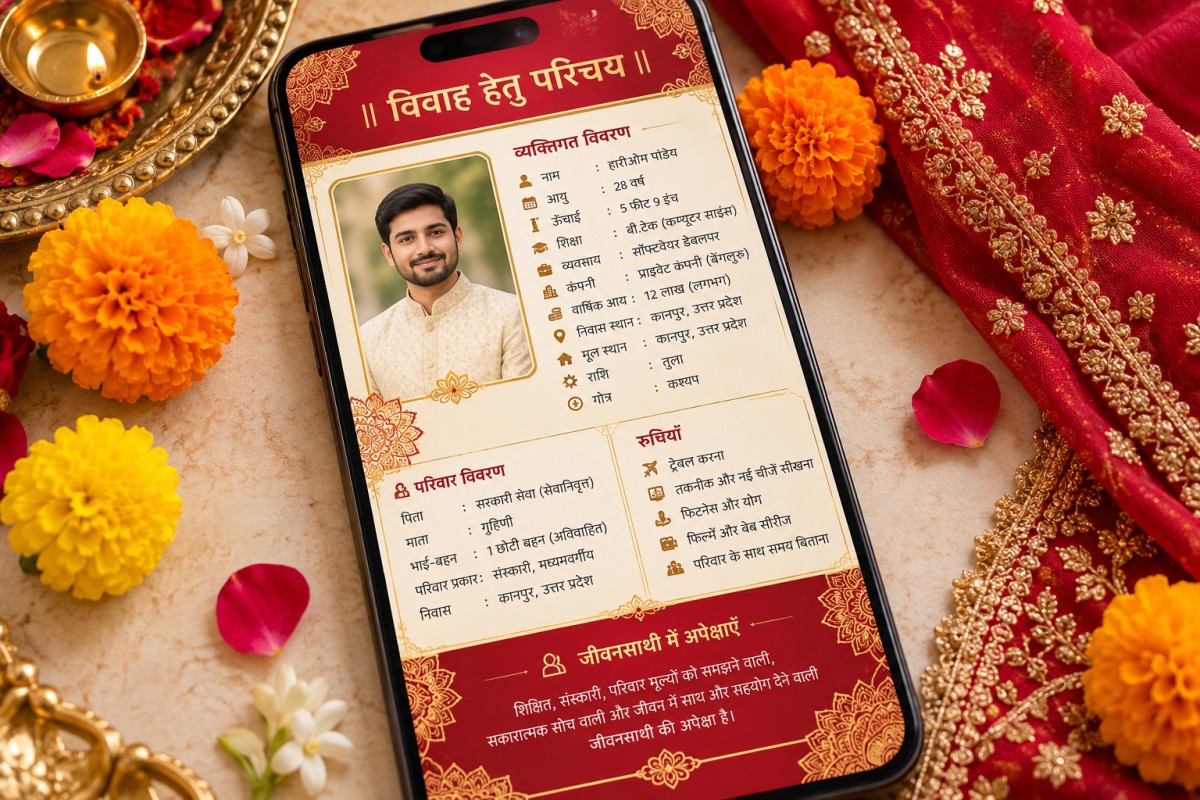
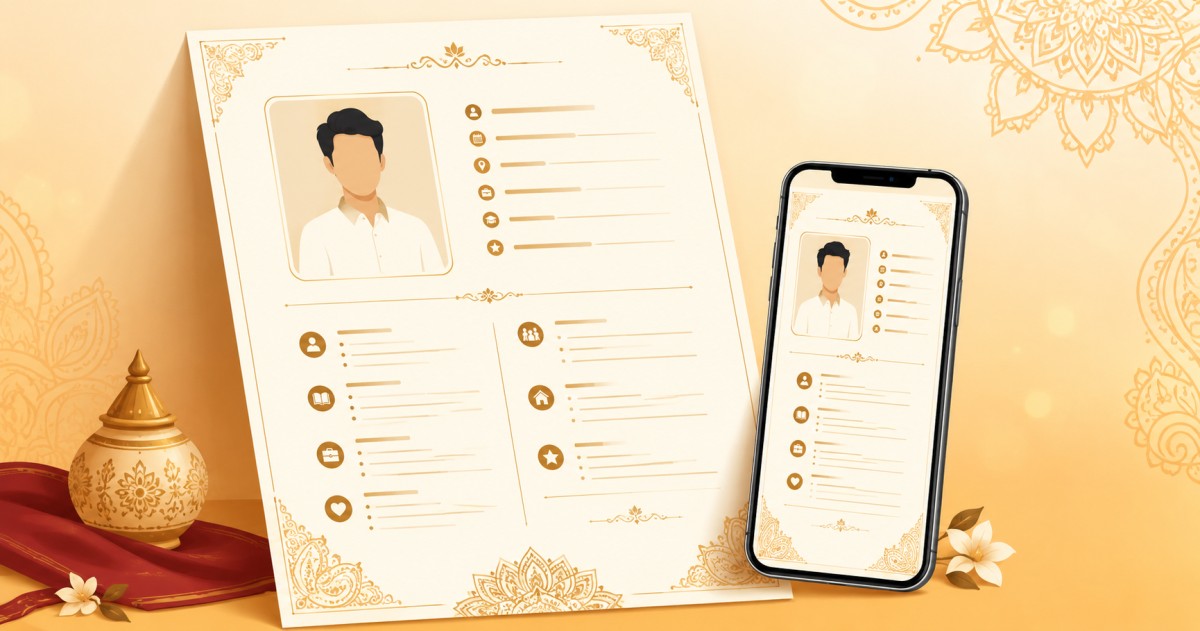
- Use a proper template. A well-designed biodata template does the visual work for you. You focus on the content; the template ensures it looks professional and credible.
This is exactly why proper biodata templates exist. A polished layout that handles typography, spacing, and visual hierarchy automatically will always outperform a hand-formatted Word document from 2015.
Mistake #7: Listing Hobbies That Sound Copy-Pasted From a Dictionary
"Reading, music, travelling, cooking, spending time with family."
Look, these are fine hobbies. But they are also the five most common answers on every biodata ever written. They provide zero signal about who you are.
Compare:
- ❌ "Hobbies: Reading, music, travelling."
- ✅ "I've been learning Hindustani classical singing for 4 years (still very much a beginner). I read mostly Indian fiction — Amitav Ghosh and Perumal Murugan especially. I do a long solo cycle ride on Sunday mornings when the city is still quiet."
The second version makes you a specific, interesting human being rather than a form someone filled in. Families who respond to the specific version are also self-selecting as people who appreciate real personality — which is exactly the compatibility filter you want working for you.
For NRI Profiles:
This section is especially valuable. Shared interests and lifestyle details do more work for NRI biodatas than for domestic ones, because the families don't have mutual acquaintances or community networks to verify your character through. Your hobbies and personal details become the trust-building content. Use this space well.
Mistake #8: No Clear Contact Information, or Contact Information That Goes Nowhere
After everything else is right, this is the mistake that kills a match at the last moment.
We saw biodatas where:
- The phone number had a typo (one digit wrong)
- The email was written as xyz AT gmail DOT com out of privacy caution — but the format confused multiple readers who tried to type it literally
- The contact person listed had no relationship identified (is this a friend? a cousin? the person themselves?)
- The number was an old number the person doesn't use anymore
- There was genuinely no contact detail on the biodata at all
If a family is interested and cannot reach you, they move on. They will not hunt for you.
What Good Contact Information Looks Like:
- Contact Person: Full name and relationship — "Anand Verma (Father), +91 98765 43210"
- Email: Written clearly — family.verma2025@gmail.com
- WhatsApp: If you have a separate or preferred WhatsApp number, list it
- For NRIs: Include your country code clearly — +1 415 555 0192 — and mention preferred timing or time zone if relevant ("IST evenings preferred")
Make it easy to reach you. Lower every possible friction between interest and contact.
What a High-Quality Marriage Biodata Actually Includes
Let's put this all together. Here is the complete checklist:
| Section | What to Include |
|---|---|
| Photo | One clear, recent, well-lit portrait photo |
| Basic Details | Full name, age, date of birth, height, marital status |
| About Me | 3–5 specific sentences — personality, upbringing, lifestyle |
| Education | Degree, institution, graduation year |
| Profession | Job title, company type, city, years of experience |
| Annual Income | Honest figure — or leave blank rather than exaggerate |
| Religion / Community | As relevant; leave blank if open |
| Family Background | Parents, siblings, family culture and location |
| Hobbies & Interests | Specific, personal, 3–5 real examples |
| Partner Preferences | Character + lifestyle — honest but not exhaustive |
| Contact Details | Name, relationship, phone (with country code), email |
The 2-Minute Biodata Audit
Before you send your biodata anywhere, run through this checklist:
- [ ] Does my About Me describe me specifically, or could it describe anyone?
- [ ] Is my photo recent, clear, and natural?
- [ ] Is every number (age, height, income) accurate?
- [ ] Have I included meaningful family background information?
- [ ] Are my partner preferences specific but not a 12-point elimination list?
- [ ] Does the whole document look clean and professional?
- [ ] Are my hobbies specific and personal, not generic filler?
- [ ] Can someone contact me easily and reach me at the number listed?
If you said no or maybe to any of these — you know what to fix.
Make a Print-Ready Biodata in Under 10 Minutes — Free
If you want to build a clean, professional marriage biodata without designing anything from scratch, MyEasyPage's free marriage biodata maker does the design work for you.
- 5 premium templates — Royal Classic, Modern Editorial, Floral Wedding, Minimal Clean, and Festive Sangeet
- Conditional sections — only the sections you fill appear on the final biodata. No blank headings, no empty fields.
- Live preview — every field you type updates the biodata in real time on the right side
- Photo upload — add your portrait directly to the biodata
- PDF, PNG, and JPG download — print-ready at 1500 × 2100 px, no watermark, no signup required
- NRI-ready — country, international income formats, and partner preference fields that work for India and abroad
The whole thing takes under 10 minutes. No account needed.
Create your free marriage biodata →
Final Thought
A marriage biodata is not just a form. It is the first version of you that hundreds of families will encounter. For many, it will be the only version.
You do not get a second chance at a first impression — but you do get a chance to make a genuinely good first impression, right now, by fixing the eight things above.
Take the 2-minute audit. Fix what needs fixing. Then send with confidence.